



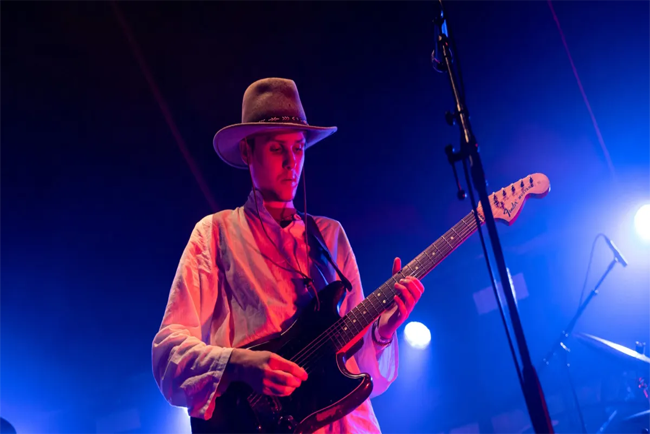
Matt Kwasniewski-Kelvin, the co-founding guitarist of Black Midi, has died at the age of 26. His family confirmed the news in a statement shared through the band’s label, Rough Trade, explaining that his death followed a long and difficult struggle with mental health.
As the news spread, tributes quickly poured in from fans, fellow musicians, and figures within the experimental rock scene. Consequently, many highlighted not only his musical innovation but also the urgent need for greater mental health awareness, particularly among young artists.
Early Life and First Steps Into Music
From an early age, Kwasniewski-Kelvin displayed a deep fascination with music. Initially, he picked up the guitar during primary school and soon developed a taste for skater-influenced punk and pop. At the same time, his father—himself a musician—played a crucial role in nurturing that interest.
For example, Kwasniewski-Kelvin often attended his father’s band rehearsals, where he was encouraged to experiment freely. By the age of 12, he was already improvising solos over blues and pop jams. As a result, he developed confidence, technical agility, and an instinctive feel for performance that would later define his career.
Meeting His Bandmates at the BRIT School
Eventually, his musical journey led him to London’s BRIT School, where he met future bandmates Geordie Greep, Cameron Picton, and Morgan Simpson. Notably, their shared curiosity for unconventional sounds quickly set them apart from their peers.
Moreover, Greep introduced Kwasniewski-Kelvin to more abrasive influences, including harsh noise, drone music, and artists such as Merzbow. Consequently, these influences expanded his musical vocabulary and pushed the group toward a more radical, experimental direction.
Read More>>Portsmouth vs Arsenal FA Cup Preview
Breakthrough Performances and South London Recognition
Soon after forming, Black Midi became known for their chaotic and electrifying live shows, particularly at Brixton’s Windmill venue. During these performances, Kwasniewski-Kelvin frequently shifted between sharp post-hardcore riffs and abstract, improvised noise. As a result, his playing style became one of the band’s defining characteristics.
At the same time, the band emerged as central figures in South London’s growing experimental rock scene. Meanwhile, they regularly shared stages with acts such as Black Country, New Road, Shame, and Jerskin Fendrix, helping shape a new musical movement.
Schlagenheim and Critical Acclaim
In 2019, after signing with Rough Trade, Black Midi released their debut album, Schlagenheim, produced by Dan Carey. Not only did the album receive rave reviews, but it also established the band as one of the most daring new acts in British rock.
Following its release, the band embarked on extensive tours across North America and Europe. However, these plans were eventually disrupted by the global pandemic. Nevertheless, Schlagenheim’s impact continued to grow, solidifying Kwasniewski-Kelvin’s reputation as a fearless and innovative guitarist.
Stepping Away and Mental Health Challenges
When Black Midi returned with their second album, Cavalcade, Kwasniewski-Kelvin was absent. Shortly afterward, he publicly explained that he had stepped away due to mental health difficulties. Importantly, he emphasized that he hoped to return once his condition improved.
In response, the band expressed unwavering support, stating that they stood fully behind their friend during his recovery. However, despite this encouragement, he did not rejoin the group for later projects, including Hellfire. Ultimately, Black Midi announced an indefinite split in 2024.
Later Work and Political Expression
After leaving the band, Kwasniewski-Kelvin remained musically active, albeit on a smaller scale. For instance, he appeared as a guest on Wu-Lu’s 2022 album Loggerhead. Meanwhile, he continued to participate casually in London’s underground music scene.
Additionally, in 2024, he released a solo recording that took a strong political stance, criticizing the British Labour Party and advocating for a free Palestine. Through this work, he demonstrated his continued willingness to challenge audiences both musically and ideologically.
Legacy and Reflection
Ultimately, Matt Kwasniewski-Kelvin leaves behind a powerful artistic legacy. His guitar work helped define Black Midi’s early sound and influenced a generation of experimental musicians. More importantly, his story underscores the urgent need for openness and support around mental health.
As his family urged in their statement, checking in on loved ones can make a difference. Although his life was tragically short, his impact on modern experimental rock will endure.
Read More>>How to Rob a Bank (2026)