



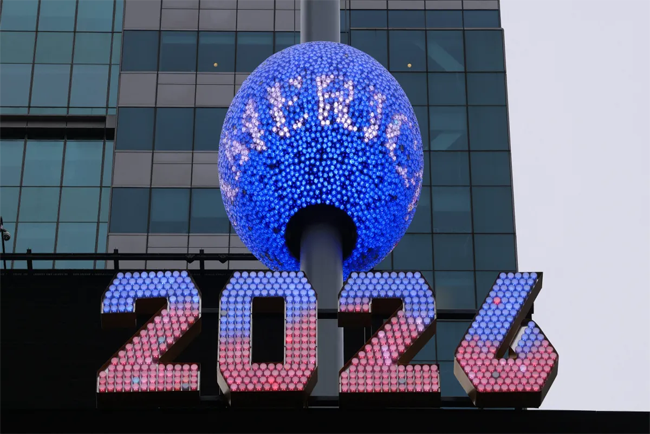
As the world prepares to welcome 2026, Times Square is once again at the center of global celebration. This year’s iconic New Year’s Eve ball drop introduces a spectacular new symbol of renewal: the Constellation Ball, the largest and most advanced ball in the history of the tradition that began in 1907.
A Record-Breaking New Year’s Eve Ball
The newly unveiled Constellation Ball measures 12.5 feet in diameter and weighs more than 12,000 pounds, making it the biggest ball ever to descend at One Times Square. It is the ninth official design used in the storied history of the Times Square ball drop.
Moreover, the ball features 5,280 circular Waterford crystals in three sizes—1.5-inch, 3-inch, and 4-inch—combined with cutting-edge LED light technology. Notably, this marks a major design shift from the triangular crystal shapes that have defined the ball since 1999.
According to organizers at One Times Square, each crystal design represents eternal positivity, symbolizing hope, unity, and continuity as the new year begins.
Symbolism Behind the Constellation Ball
Michael Phillips, president of Jamestown, the firm that owns and operates One Times Square, explained that the Constellation Ball reflects interconnectedness and wholeness. In essence, it honors the ongoing relationship between the past, present, and future—values deeply embedded in New Year’s Eve celebrations.
The ball was officially raised into position in November, signaling the start of anticipation for the year-end festivities.
Read More>>The Invite (2026)
A Global Countdown Watched by Millions
Every year at 11:59 p.m., the illuminated ball glides down its pole as crowds in Times Square—and millions more watching worldwide—count down the final 60 seconds of the year. At midnight, cheers erupt, confetti rains down, and loved ones share the traditional New Year’s kiss.
As a result, the Times Square ball drop has become one of the most watched annual events on television and digital platforms, representing unity across cultures and continents.
Origins of the Times Square Ball Drop Tradition
The tradition began in 1907, thanks to Jacob Starr, a Ukrainian immigrant metalworker, and Adolph Ochs, publisher of The New York Times. Initially, Ochs attracted crowds with fireworks atop the newspaper’s headquarters. However, when city officials banned pyrotechnics, a new idea was needed.
Consequently, Ochs commissioned Starr—who worked at Strauss Signs (later Artkraft Strauss)—to create a visually striking alternative. The result was a glowing ball lowered at midnight, inspired by 19th-century nautical time balls used by ship navigators to synchronize chronometers.
Electricity, Innovation, and Instant Popularity
At the time, electricity was still a novelty. In fact, according to historical records, many American homes relied on gas or candlelight well into the 1920s. Therefore, watching an illuminated ball descend from the night sky felt almost magical.
Tama Starr, Jacob Starr’s granddaughter and former foreperson of the ball drop, has long believed the original concept belonged to her grandfather. She recalled that the ball was manually lowered starting one minute before midnight and transformed into glowing numerals marking the new year.
Unsurprisingly, the spectacle captivated the public immediately. Restaurants and hotels even joined in, with staff wearing illuminated top hats displaying the new year.
How the Ball Has Evolved Over Time
Over the decades, the Times Square ball has evolved dramatically. Designs have ranged from a 700-pound iron sphere with simple bulbs to an aluminum version after World War II, and even a whimsical “Big Apple” during the tenure of Mayor Ed Koch.
By the mid-1990s, modern technology took over. Rhinestones, strobe lights, and computer controls replaced traditional craftsmanship, marking the end of Artkraft Strauss’s direct involvement.
“A Minute Outside of Time”
Despite the changes, the emotional power of the countdown remains unchanged. Tama Starr described the final minute of the year as “a minute outside of time.” In that fleeting moment, people reflect, reset, and resolve to be better.
Ultimately, the Constellation Ball continues this legacy—blending history, innovation, and human connection—ensuring that as 2026 begins, the world once again looks to Times Square for inspiration.
Read More>>Iowa vs Vanderbilt ReliaQuest Bowl 2025