



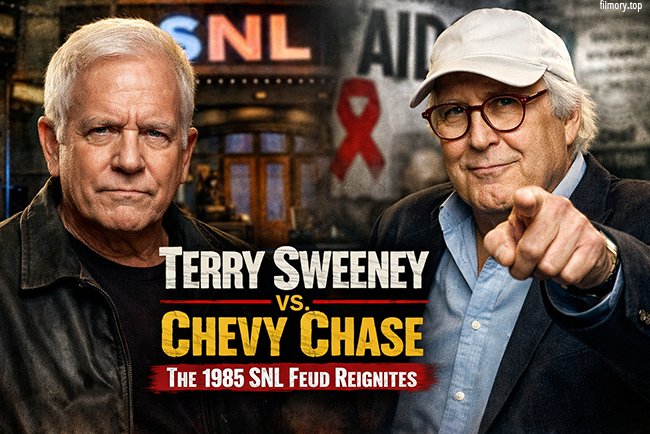
Terry Sweeney made television history during Saturday Night Live’s 1985–86 season. He became the show’s first openly gay cast member and, at the time, the only out gay performer on network television. His presence marked a major cultural milestone, yet it also placed him in an isolating and often hostile environment. Nearly four decades later, Sweeney, now 75, is revisiting one of the most painful episodes of that era—his long-standing feud with Chevy Chase.
The Controversial 1985 Hosting Incident
The dispute traces back to November 1985, when Chevy Chase returned to host SNL during Season 11. According to Sweeney, Chase entered the writers’ room, asked who the “gay one” was, and proposed a sketch mocking AIDS-related weight loss. At that time, the AIDS epidemic was devastating gay communities worldwide. Fear, stigma, and loss dominated daily life for many LGBTQ+ people. As a result, Sweeney says the joke landed not as comedy but as cruelty.
He has repeatedly described the room falling silent. Feeling humiliated and unsafe, he walked out. For Sweeney, the moment symbolized how casually powerful figures treated AIDS and how easily humor was weaponized against marginalized colleagues.
Read more >> Madden (2026): Nicolas Cage Brings John Madden’s Legendary Football Story to Life
The CNN Documentary Reopens Old Wounds
The incident resurfaces in the new CNN documentary I’m Chevy Chase and You’re Not, directed by Marina Zenovich and premiering January 1. Although Chase participated in the film, Sweeney declined. Zenovich confronts Chase on camera with the alleged joke, referencing Live From New York: The Complete, Uncensored History of Saturday Night Live by Tom Shales and James Andrew Miller.
In the book, Sweeney recounts that Chase later apologized but appeared angry that he had to do so. Chase flatly denies this account in the documentary, calling it untrue and accusing Sweeney of lying. He insists the story does not reflect who he is, adding that if it did, he would have to live with it for the rest of his life.
Read more >> Liverpool vs Leeds United live score, H2H results, standings and prediction
Sweeney’s Sharp Public Response
Sweeney did not remain silent. Speaking to The Hollywood Reporter, he reacted bluntly to Chase’s comments. He expressed disbelief at Chase’s claim that Sweeney might be dead, calling the remark further proof of Chase’s behavior. In a separate interview with the New York Post, Sweeney delivered an even harsher assessment, likening Chase to “one of those turds you flush… but it comes back up again.”
His language may sound extreme, yet it reflects decades of unresolved anger. Sweeney has maintained that the 1985 incident shaped his experience on the show and reinforced how alone he felt as the only openly gay cast member.
Lorne Michaels and the Culture of Comedy
SNL creator Lorne Michaels also appears in the documentary. He frames the moment as a byproduct of the show’s culture during the 1980s. Michaels explains that writers and performers often said shocking things to make each other laugh, assuming everyone in the room shared the same comedic boundaries.
However, critics argue that this explanation ignores power dynamics and context. AIDS was not abstract. It was killing friends, partners, and colleagues. For Sweeney, the joke was not edgy comedy. It was a reminder that empathy often stopped at the punchline.
A Pattern Beyond SNL
The documentary places the Sweeney dispute alongside other controversies from Chase’s career. Former Community collaborators recount on-set conflicts, including a 2012 incident involving racially charged language. Actress Yvette Nicole Brown publicly distanced herself from the film, rejecting attempts to reframe Chase’s firing from the series.
Zenovich presents these moments without giving Chase editorial control. Her goal, she says, is to examine the contradictions that have followed him for decades, from groundbreaking success to repeated accusations of abusive behavior.
Why the Story Still Matters
Sweeney’s renewed comments arrive during a broader reassessment of comedy’s past. Jokes once dismissed as “of their time” now face deeper scrutiny. For Sweeney, the issue has never been about canceling anyone. It has always been about acknowledging harm.
The 1985 exchange remains, in his view, a symbol of how easily LGBTQ+ lives were trivialized during the AIDS crisis. Revisiting it today forces audiences to ask who felt safe in comedy spaces—and who never did.