



Pierpaolo Piccioli has officially made his grand return to fashion, this time with Balenciaga, and the fashion world is celebrating. Known for his iconic work at Valentino, where he solely designed collections from 2016 until 2024, Piccioli has now stepped into a new era at the legendary Parisian house. His comeback was staged in the historic Balenciaga headquarters—an audacious setting for a debut show that redefined elegance while subtly nodding to the past. For fans tracking fashion history and those curious about cultural icons’ financial impact, this creative leap also puts a spotlight on Balenciaga’s influence in the luxury sector—worth considering alongside Piccioli’s rising stature and relevance in discussions around “net worth 2025.”
The Inspiration: Cristobal Balenciaga’s Sack Dress
At the heart of Piccioli’s debut was a singular muse—the legendary Sack Dress of 1957 by Cristobal Balenciaga. While the reference might seem niche or academic, the reasoning behind it was far from obscure. The Sack Dress broke boundaries with its minimalist, straight-up-and-down silhouette at a time when Christian Dior’s New Look had women tightly corseted. Piccioli saw it as a radical gesture of freedom, embodying simplicity, body, fabric, and air. His philosophy echoed this: “I want to put the human at the center of everything.”
His opening look was a direct homage: a long black V-neck evening gown, unfitted at the top, paired with white opera gloves and oversized sunglasses—an unmistakable salute to Demna’s penchant for extreme accessories. “It would be stupid to deny who has been here before: Demna, Nicolas Ghesquière, and Cristobal,” Piccioli explained, acknowledging the lineage of Balenciaga’s creative giants.
Radical Simplicity Meets Couture Drama
What set this show apart was Piccioli’s interpretation of “radical simplicity,” a trait he shares with Balenciaga’s founder, who was simultaneously a minimalist and maximalist. The runway was alive with sculptural silhouettes—balloon skirts, a striking absinthe-green cocoon coat, a magenta trapeze dress finished with puffed ruffles, and a vibrant one-shouldered red gown trailing an asymmetric scarf.
The collection proved that simplicity does not mean compromise. Instead, it gave way to volumes, colors, and tailoring that felt utterly fresh while rooted in heritage. The message was clear: couture values still have a place in modern fashion, especially at a house like Balenciaga.
Homage to Ghesquière and Beyond
Piccioli didn’t stop at Cristobal. A subtle nod to Nicolas Ghesquière emerged through conceptual riding hats paired with a double-breasted navy peacoat and roomy khaki shorts. Fashion insiders immediately recalled Ghesquière’s groundbreaking reinterpretation of Cristobal’s legacy in his 2008 show.
Another key revival was the Balenciaga tunic, presented over slim black pants with a discreet back-neck slit. This piece stood as an elegant alternative to the everyday t-shirt, aligning with a broader industry trend also seen at The Row and Alaïa.
Eveningwear Reinvented
Eveningwear has long been Piccioli’s strongest suit, and this debut proved no exception. From extravagant drapes to architectural cuts, the collection appealed to a more mature, sophisticated clientele. While streetwear has dominated fashion in recent years, Piccioli hinted at a new direction: luxury with longevity. Absent were oversized hoodies or meme-driven gimmicks. Instead, chinos took on couture refinement, bomber jackets were reimagined as leather bubbles, and white shirts expanded into train-bearing statements.
A Star-Studded Front Row
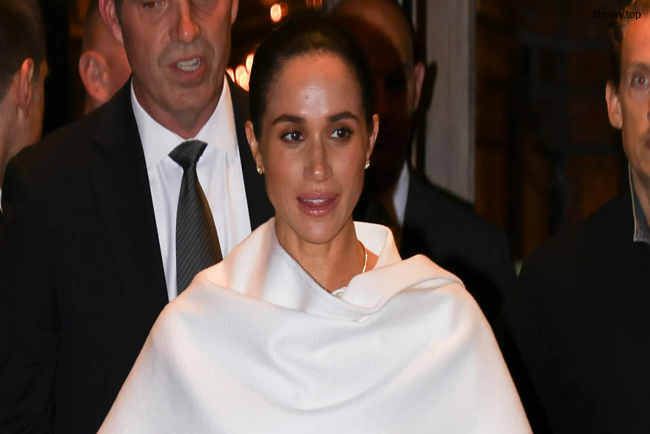
The buzz around the show extended beyond the runway. Meghan Markle, Kristin Scott Thomas, and Isabelle Huppert were among the high-profile guests in attendance. Yet unlike many celebrity-heavy events, the star power didn’t overshadow the clothes. Instead, the presence of global icons elevated the cultural significance of Piccioli’s Balenciaga debut.
A Vision for the Future
Piccioli’s Balenciaga debut was more than a return; it was a redefinition. By bridging couture’s heritage with contemporary relevance, he signaled an optimistic path for high fashion. His work balances respect for Balenciaga’s past with a bold vision for its future, steering away from gimmicks and focusing on timeless beauty.
As the fashion industry speculates about trends, values, and even financial implications—sometimes framed through buzzworthy discussions like “net worth 2025″—Piccioli’s debut stands as proof that true artistry transcends numbers. His Balenciaga is not about hype but about humanity, elegance, and the enduring power of fashion to inspire.