



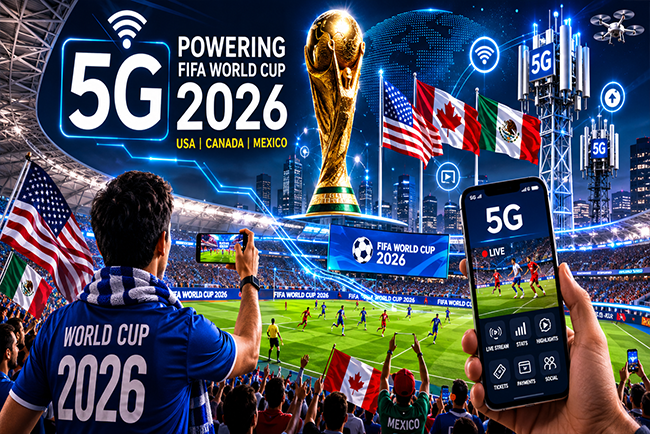
The FIFA World Cup 2026 is set to become the largest tournament in football history, featuring 48 teams, 104 matches, and host venues across the United States, Canada, and Mexico. While fans are preparing for the excitement on the pitch, telecommunications companies are gearing up for a different challenge: delivering reliable and high-speed 5G connectivity to millions of visitors.
The deployment of 5G in the FIFA World Cup 2026 is expected to be one of the most significant tests of mobile network infrastructure ever conducted. Major operators such as Verizon, AT&T, and Rogers are investing heavily to ensure seamless communication, streaming, and digital services throughout the tournament.
Why 5G Matters at the FIFA World Cup 2026
Modern sporting events rely heavily on mobile connectivity. Fans use smartphones to share videos, post on social media, stream content, access digital tickets, make cashless payments, and follow live statistics.
However, the challenge extends beyond stadiums. Massive crowds will gather at airports, train stations, hotels, restaurants, fan zones, and tourist attractions. As a result, telecom operators must provide strong network coverage across entire host cities rather than focusing solely on match venues.
This widespread demand makes the FIFA World Cup 2026 a crucial test of how advanced 5G networks can handle extreme traffic loads in real-world conditions.
Read More>>Autism Spectrum Disorder
Verizon Expands Capacity for Massive Data Demand
As the official telecommunications sponsor of the FIFA World Cup 2026, Verizon is playing a central role in the tournament’s digital infrastructure.
The company estimates that a single match could generate more than 50 terabytes of mobile data usage inside a stadium. To accommodate this demand, Verizon has expanded its 5G spectrum and increased network capacity by three to five times at host venues.
The operator has also deployed thousands of antennas beneath stadium seats and installed advanced 4G and 5G systems designed to support large crowds.
These upgrades are essential because today’s fans are not just consuming content—they are creating it. Thousands of spectators will simultaneously upload videos, stream live content, and interact online, putting immense pressure on network performance.
Private 5G Networks Support Tournament Operations
The role of 5G in the FIFA World Cup 2026 goes far beyond fan connectivity.
Verizon plans to deploy private 5G networks to support critical tournament operations. One example is the use of referee body cameras, which require reliable, low-latency data transmission.
The company will also provide infrastructure for broadcasting operations through its high-capacity fiber and wireless services. These networks connect stadiums to the International Broadcast Center, ensuring that live footage reaches billions of viewers worldwide without interruption.
Another important innovation is 5G network slicing. This technology allows network resources to be allocated based on priority.
For example, emergency services, broadcasting teams, and tournament officials can receive dedicated network access even when public traffic reaches peak levels. This ensures that mission-critical communications remain stable throughout the event.
Read More>>Voicemails for Isabelle (2026) Movie Preview
AT&T Strengthens U.S. Host Cities
Although AT&T is not an official FIFA sponsor, the company is making significant investments to prepare for increased demand.
AT&T has upgraded connectivity across all 11 U.S. World Cup stadiums and improved coverage at airports, transportation hubs, and other key locations. The operator reports more than 2,000 network enhancements and over 90 upgraded small-cell sites.
The company expects network traffic to increase significantly during the tournament and has designed its infrastructure to support two to three times normal usage levels.
AT&T is also offering eSIM solutions for international travelers, making it easier for visitors to stay connected while moving between the United States, Canada, and Mexico.
Canada Expands 5G Infrastructure
Canadian telecommunications giant Rogers has invested millions of dollars to strengthen its network ahead of the World Cup.
The company completed a CAD 22 million upgrade around BMO Field in Toronto and surrounding areas. Improvements include expanded 5G+ coverage, stronger wireless infrastructure inside the stadium, and enhanced connectivity at nearby hotels, transit stations, fan zones, and Toronto Pearson International Airport.
Rogers has also invested additional resources in Vancouver, including upgrades near BC Place Stadium and other major gathering locations.
Mexico Uses Additional Spectrum to Boost Connectivity
Mexico is taking a unique approach by temporarily expanding spectrum availability for telecommunications providers.
Regulators have granted temporary access to additional frequencies for operators including Telcel, AT&T Mexico, and Altan. These frequencies cover key bands such as 600 MHz, 1.9 GHz, 2.5 GHz, and 3.3–3.6 GHz.
The additional spectrum will help strengthen mobile coverage around stadiums, airports, and fan zones in Mexico City, Guadalajara, and Monterrey.
This collaboration between regulators and telecom companies demonstrates how governments can support large-scale events by ensuring networks have sufficient capacity during periods of extraordinary demand.
A Blueprint for Future Global Events
The FIFA World Cup 2026 will provide valuable lessons for future sporting events, concerts, and large public gatherings worldwide.
As mobile users increasingly expect uninterrupted service, operators must invest in technologies such as small cells, distributed antenna systems, network slicing, and real-time traffic monitoring.
The success of 5G in the FIFA World Cup 2026 could set new standards for connectivity at major events and showcase how next-generation networks can support millions of simultaneous users without compromising performance.
With billions of fans watching and millions attending in person, the tournament may become the ultimate demonstration of what modern 5G technology can achieve.