



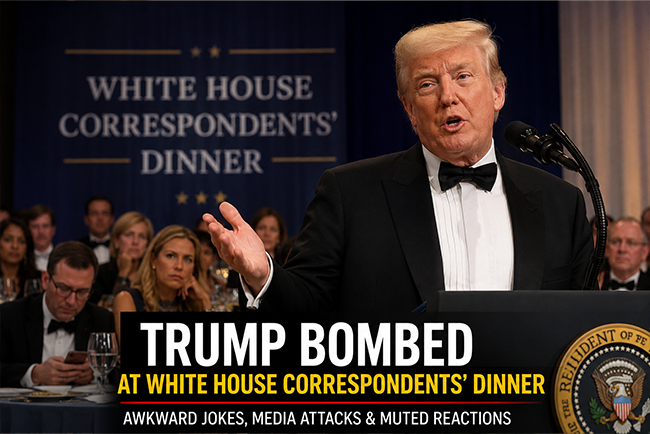
Donald Trump’s return to the White House Correspondents’ Dinner sparked significant attention, but not for the reasons his supporters may have hoped. Instead of delivering a memorable comedy routine, the president faced widespread criticism after an hour-long speech that many attendees and political observers described as awkward, repetitive, and lacking humor.
The highly anticipated appearance marked Trump’s first attendance at the annual event after years of boycotting the White House Correspondents’ Association dinner. While expectations were high, many journalists and guests felt the speech resembled a campaign rally more than a traditional black-tie gathering.
Trump Struggles to Connect With the Audience
Throughout the evening, Trump attempted to entertain the audience with jokes aimed at journalists, political rivals, and media organizations. However, many of his punchlines failed to generate laughter.
At several points, Trump even acknowledged that his own jokes were falling flat. Unfortunately for the president, even those self-aware remarks received little response from the crowd.
His speech included recycled political nicknames, personal insults, and repeated criticism of major news outlets. Instead of energizing the audience, the lengthy routine left many attendees quietly watching or shifting their attention elsewhere.
Media Freedom Becomes an Unintended Theme
Ironically, Trump’s appearance highlighted one of the central themes of the evening—freedom of the press.
After the event, journalists and commentators openly criticized the president’s performance across television, newspapers, and social media. In many countries, such public criticism of national leaders could carry legal consequences. However, in the United States, the First Amendment protects both free speech and press freedom.
Trump himself acknowledged this principle during his remarks.
“In this country, we believe in freedom of speech,” he said while condemning political violence and praising the U.S. Secret Service.
The statement came during one of the few moments in the speech that received a more positive reception.
Trump Targets Major Media Organizations
As expected, Trump devoted a large portion of his speech to criticizing the news media.
He singled out several CNN journalists by name and continued his long-running attacks on major news organizations. Following the event, CNN defended its newsroom.
The network stated that it would continue reporting independently without government interference, emphasizing that honest journalism remains protected under the U.S. Constitution.
Trump also praised media executives he considers allies, including David Ellison, who recently gained control of Paramount and has been linked to future media acquisitions.
Read More>>NK Aluminij Kidričevo vs Dinamo City
Crowd Appears Uninterested
As the speech continued, many attendees reportedly lost interest.
According to journalists inside the ballroom, guests began checking their phones, talking with colleagues, leaving their tables, or eating dessert while Trump continued speaking.
Some political insiders reportedly questioned the quality of the speech itself. One Republican source was quoted as saying the person responsible for writing the speech “should be fired.”
Even television executives reportedly described the event as unusually low-energy compared to previous White House Correspondents’ Dinners.
Journalism Awards Highlight Press Freedom
One of the evening’s most notable moments occurred during the presentation of the White House Correspondents’ Association journalism awards.
Trump remained seated while reporters from The Wall Street Journal accepted an award for investigative reporting related to Jeffrey Epstein and a controversial birthday letter allegedly bearing Trump’s name.
During the presentation, speakers referenced Trump’s ongoing lawsuit against the newspaper and noted that one reporter’s family required relocation after her personal address became public.
Despite the legal dispute, Trump stood and shook hands with the award-winning journalists, creating one of the evening’s more unexpected moments.
Trump Addresses 2028 Speculation
Near the end of the event, Trump briefly reignited discussion about a potential third presidential campaign by wearing a red “Trump 2028” hat.
Although the gesture immediately drew attention, he clarified that he was joking about another run for office. He also acknowledged that his current presidential term would eventually come to an end, commenting that he would only be using the White House ballroom for “about six months.”
The remarks represented a rare public acknowledgment that constitutional term limits remain in place.
Read More>>Trick ‘r Treat 2: Everything We Know About the Long-Awaited Horror Sequel (2026)
White House Correspondents’ Association Defends Press Independence
Before introducing Trump, White House Correspondents’ Association President Weijia Jiang delivered remarks emphasizing the importance of a free and independent press.
She explained that while criticism of journalists is healthy in a democracy, efforts to undermine the press threaten constitutional values.
Addressing Trump directly, Jiang said the relationship between presidents and reporters has always involved tough questions and difficult answers. She concluded by describing the First Amendment as “a done deal” worthy of celebration.
Donald Trump’s return to the White House Correspondents’ Dinner generated headlines, but much of the attention focused on the audience’s muted response rather than the president’s jokes.
Although his supporters may celebrate several of his remarks online, many journalists and attendees viewed the speech as one of the least engaging performances in the event’s recent history. Nevertheless, the evening ultimately reinforced an enduring principle of American democracy: the protection of free speech and an independent press.