



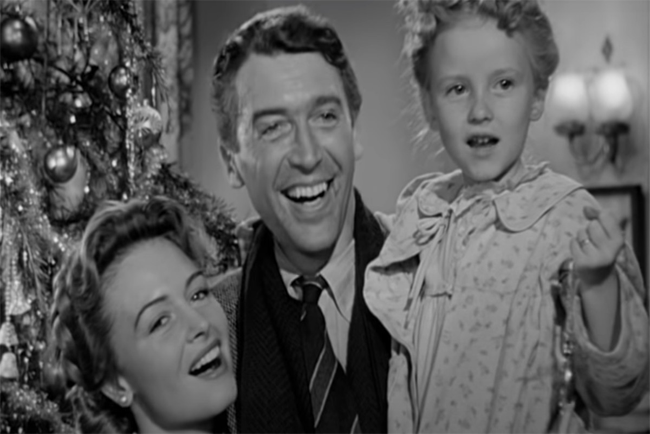
As the holiday season fills the air with warmth and reflection, film lovers around the world pause to celebrate a defining moment in cinema history. On December 20, 1946, It’s a Wonderful Life premiered at New York City’s Globe Theatre. Directed by Frank Capra, the film would later become one of the most beloved Christmas movies of all time—although its rise to legendary status was far from immediate.
A Modest Premiere with a Lasting Impact
The first screening of It’s a Wonderful Life was a charity preview, held one day before its official theatrical release. At the time, few could have predicted that this heartfelt drama would become a symbol of Christmas, hope, and redemption for generations. Today, nearly eight decades later, the film remains a seasonal tradition across the globe.
Starring James Stewart as George Bailey, Donna Reed as Mary Bailey, and Lionel Barrymore as the ruthless Mr. Potter, the film marked Capra’s first major project after returning from World War II. It was produced by Liberty Films and distributed by RKO Radio Pictures.
The Story That Defined a Season
At its core, It’s a Wonderful Life tells the story of George Bailey, a small-town building and loan operator in Bedford Falls. Burdened by financial failure and personal sacrifice, George reaches his lowest point on Christmas Eve. However, divine intervention arrives in the form of Clarence Odbody, his guardian angel, played by Henry Travers.
Clarence shows George an alternate reality—one in which he never existed. Through this haunting vision, George realizes how profoundly his kindness and selflessness shaped the lives around him. The message is simple yet powerful: one life can change everything.
Read More>>Mardaani 3 Movie (2026)
From Short Story to Silver Screen
The film’s origins trace back to a short story titled The Greatest Gift, written by Philip Van Doren Stern in 1939. After failing to find a publisher, Stern printed the story as Christmas cards and shared them with friends in 1943. One copy eventually reached Hollywood, capturing Capra’s attention.
Capra purchased the rights in 1945 and recognized the story’s emotional depth. Given the post-war climate, themes of sacrifice, resilience, and community resonated strongly with American audiences returning to civilian life.
Innovative Filmmaking and Personal Performances
Filming took place between April and July 1946 on a massive set in Encino, California. The production recreated Bedford Falls with over 75 buildings and a 300-yard-long Main Street. To simulate snow, Capra’s team invented a quieter artificial snow using foamite and soap flakes—an innovation at the time.
James Stewart’s performance stands out as especially raw and authentic. Having served as a bomber pilot during the war, Stewart infused George Bailey with emotional vulnerability drawn from his own experiences. Meanwhile, Donna Reed won hearts with her portrayal of Mary, a character defined by quiet strength and unwavering love.
A Box Office Disappointment Turned Cultural Phenomenon
Despite its ambition and emotional weight, It’s a Wonderful Life struggled upon release. Competing with films like The Best Years of Our Lives, it earned approximately $3.3 million against a $3.7 million budget, resulting in a financial loss. Although it received five Academy Award nominations, including Best Picture and Best Actor, it won none.
However, the film’s fate changed dramatically in the 1970s. Due to a copyright renewal oversight in 1974, the movie entered the public domain. Television stations began airing it frequently during the holidays, introducing it to a new generation. This exposure transformed the film into a Christmas staple.
Legacy and Lasting Influence
Today, It’s a Wonderful Life is firmly cemented in pop culture. The American Film Institute ranks it among the greatest American films ever made. Its themes have inspired countless parodies, stage adaptations, and television homages.
Memorable trivia adds to its charm. Actress Karolyn Grimes, who played Zuzu Bailey, delivered the iconic line, “Every time a bell rings, an angel gets his wings.” Capra’s pet raven, Jimmy, also makes a rare on-screen appearance.
Why It Still Matters Today
Seventy-nine years after its premiere, It’s a Wonderful Life continues to resonate in a world dominated by digital effects and fast-paced entertainment. Its enduring power lies in its humanity. The film reminds us that success is not measured by wealth, but by relationships, compassion, and purpose.
As George Bailey learns, “No one is a failure who has friends.” That message remains as meaningful today as it was in 1946.
Read More>>Barcelona’s Andreas Christensen Suffers Knee Injury