



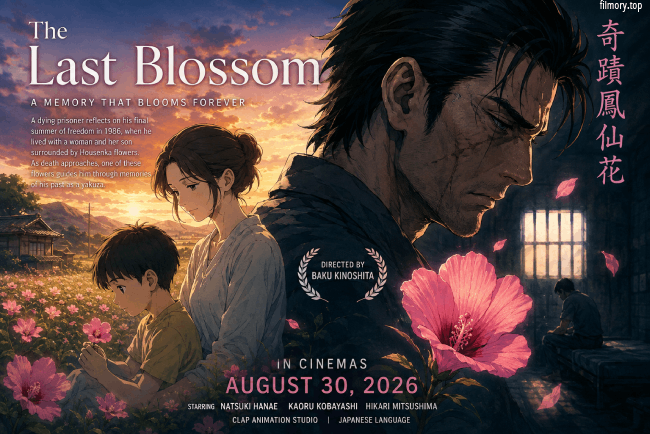
The Last Blossom is a Japanese animated drama directed by Baku Kinoshita. The film combines crime, memory, family, regret, and mortality. Its story follows a dying prisoner who looks back at one important summer in 1986. During that summer, he lived with a woman and her son while Housenka flowers surrounded their home. As his final days approach, a single flower becomes a doorway to his troubled past.
The movie uses a reflective narrative instead of a conventional crime story. Therefore, its emotional power comes from memories and relationships. The story also explores how people carry their past long after their actions have ended.
Movie Details
| Category | Details |
|---|---|
| Movie | The Last Blossom |
| Director | Baku Kinoshita |
| Writers | Baku Kinoshita, Kazuya Konomoto |
| Genre | Animation, Drama |
| Country | Japan |
| Language | Japanese |
| Release Date | August 30, 2026 |
| Production Company | Clap Animation Studio |
| Also Known As | 奇蹟鳳仙花 |
A Prisoner Facing His Final Days
At the center of The Last Blossom is a prisoner approaching death. His present life forces him to confront memories that he cannot escape. Instead of focusing only on his imprisonment, the film moves between the present and his past.
The narrative takes audiences back to 1986. At that time, he experienced a very different life. He stayed with a woman and her young son in a home surrounded by Housenka flowers. This peaceful environment contrasts strongly with his later connection to the yakuza.
The Meaning of the Housenka Flower
The Housenka flower plays a special role in the film. It is not simply part of the background. One flower becomes connected to the prisoner’s memories and helps guide him through important moments from his life.
This gives the film a poetic quality. The flower becomes a symbol of memory, time, and emotional attachment. Moreover, its presence connects the character’s peaceful past with his violent history.
Read more >> Days of Thunder 2: Anne Hathaway Joins Tom Cruise
A Story About the Yakuza Past
The prisoner’s memories gradually reveal his earlier life as a yakuza. However, the film appears more interested in the human consequences of that life than in glorifying organized crime.
His past actions influence the people around him. Therefore, the story becomes an examination of guilt, responsibility, and regret. The contrast between his criminal history and his 1986 family-like life creates much of the film’s emotional tension.
Read more >> Celta Vigo vs Athletic Club: Live Score & Prediction
Family, Love and Lost Time
The relationship between the prisoner, Nana Nagata, and her son forms an important emotional foundation. His time with them represents a period when another future seemed possible.
These memories become especially painful as death approaches. The film asks whether a person can find meaning in the moments they shared with others. It also considers whether genuine affection can survive alongside terrible mistakes.
Voice Cast and Performances
Natsuki Hanae voices Kensuke Nagata, the central character. Kaoru Kobayashi voices Akutsu in the 1986 timeline, while Hikari Mitsushima voices younger Nana Nagata.
Yoshiko Miyazaki portrays older Nana. The supporting cast includes Hideaki Murata, Kouta Nakayama, Sôma Saitô, Pierre Taki, Junki Tozuka, and Hiroki Yasumoto. Pierre Taki provides the voice of the Housenka Flower, adding another unusual layer to the film’s symbolic storytelling.
Baku Kinoshita’s Direction
Baku Kinoshita serves as both director and co-writer, alongside Kazuya Konomoto. His approach places emotional atmosphere alongside the narrative.
The combination of animation and drama allows memories to feel dreamlike. Scenes from 1986 can carry a different emotional texture from the prisoner’s present. As a result, the film can move between realism and symbolism without losing its central theme.
Final Analysis: A Quiet Story About Redemption
The Last Blossom presents crime through the perspective of memory and consequence. Its central prisoner is not simply a former yakuza. He is also a man confronting the people, choices, and moments that shaped his life.
The Housenka flower gives the story its strongest symbolic image. It connects the past and present while reminding the character of a life that might have taken another direction. Ultimately, the film appears to ask a powerful question: Can a person find peace when there is no time left to change the past?
With its Japanese animation, dramatic storytelling, distinctive voice cast, and emotional exploration of mortality, The Last Blossom offers a thoughtful cinematic experience for audiences interested in character-driven anime dramas.