



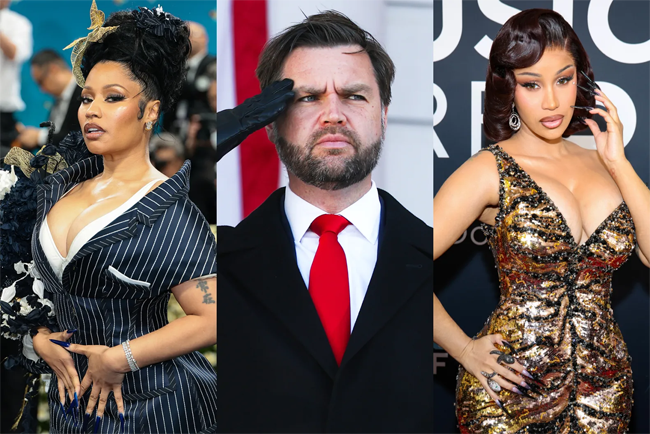
This week in American politics blended serious policy developments with viral spectacle. The U.S. government seized an oil tanker off Venezuela’s coast, and the Trump administration opened applications for a controversial million-dollar expedited visa program. Meanwhile, the Supreme Court heard oral arguments on campaign finance restrictions that could shape Vice President J.D. Vance’s future presidential ambitions.
Despite these high-stakes events, online attention shifted toward pop culture. Vance injected himself into a long-dormant rap rivalry between Nicki Minaj and Cardi B, signaling how deeply entertainment and politics now overlap.
JD Vance Publicly Backs Nicki Minaj
Vice President Vance sparked discussion when he posted “Nicki > Cardi“o
Although the exchange appeared playful, it highlighted a growing trend. The White House increasingly uses pop culture language, memes, and celebrity engagement to dominate online conversations and energize supporters.
Nicki Minaj’s Evolving Political Alignment
Nicki Minaj has played a visible role in this cultural crossover. She recently amplified posts featuring Donald Trump alongside Elon Musk and shared a video praising Trump’s accomplishments during his second term. That video highlighted policies many critics describe as xenophobic and transphobic.
Reports also indicate that Trump adviser Alex Bruesewitz helped facilitate Minaj’s recent appearance at the United Nations Headquarters,
To
I
During Trump’s second term, immigration enforcement has accelerated dramatically. Deportations have reportedly increased tenfold, and multiple deaths have occurred inside immigration detention facilities. Investigative reports also revealed that authorities deported U.S. citizen children with cancer diagnoses alongside their mothers earlier this year.
Over the summer, Immigration and Customs Enforcement (ICE) expanded operations nationwide. At the same time, White House and Department of Homeland Security social media accounts began using trending music and memes to promote enforcement actions. Critics argue that this approach trivializes human suffering while normalizing harsh policies.
Read More>>“The Drama” (2026)
Artists Rej
While Nicki Minaj welcomed the attention, many artists strongly opposed the White House’s tactics.
Last month, the White House posted a TikTok featuring Donald and Melania Trump set to a viral mashup that included Minaj’s “Beez in the Trap.” Minaj praised the video in the comments and jokingly offered “unlimited backstage Gag City for life” to whoever uploaded it.
Later, she acknowledged the surreal nature of the moment. “Idk what timeline we’re on right now,” she wrote on X. “I’m just goin w/ the flow.”
Other artists responded with outrage instead of humor.
Singer SZA criticized the administration for using pop music as political bait, calling the strategy “dark, inhuman, and boring.” Similarly, Sabrina Like condemned the use of her song “Juno” in a video showing ICE agents making arrests. She labeled the video “evil and disgusting,” prompting the White House to delete the post.
In November, Olivia Rodrigo objected after DHS used her song “All-American Bitch” in a video encouraging undocumented people to self-deport. She publicly demanded that officials stop using her music to promote “racist, hateful propaganda.”
British singer Jess Glynne also spoke out after the White House attempted to capitalize on the “Nothing Beats a Jet2 Holiday” trend. She stated clearly that her music promotes unity and love, not division or hate.
What Vance’s Comment Really Signals
Vance’s decision to comment on a rap feud may appear insignificant. However, it reflects a larger political shift. The administration now blends entertainment, internet culture, and governance more aggressively than ever before.
By embracing memes and celebrity moments, the White House aims to control narratives and energize its base. Yet this strategy also risks backlash, especially when officials pair viral content with aggressive immigration enforcement.
As deportations rise and public scrutiny intensifies, the collision between pop culture and politics continues to shape modern governance. Whether this approach builds support or deepens distrust remains unclear. What is certain is that American politics now operates fully within the viral age.